



















It’s four weeks before the audit. You open the folder where the documentation should be—and realize: Level 3 is incomplete, the EnPIs haven’t been updated in months, and no one can remember exactly where last year’s energy assessment was filed.
Does this sound familiar? If so, you’re not alone. Most companies we work with at Blue Bee Intelligence start their audit preparation reactively — and only then realize how much is still missing.
What if you could know your complete ISO 50001 status in 20 minutes—with a clear prioritization of what you need to tackle first?
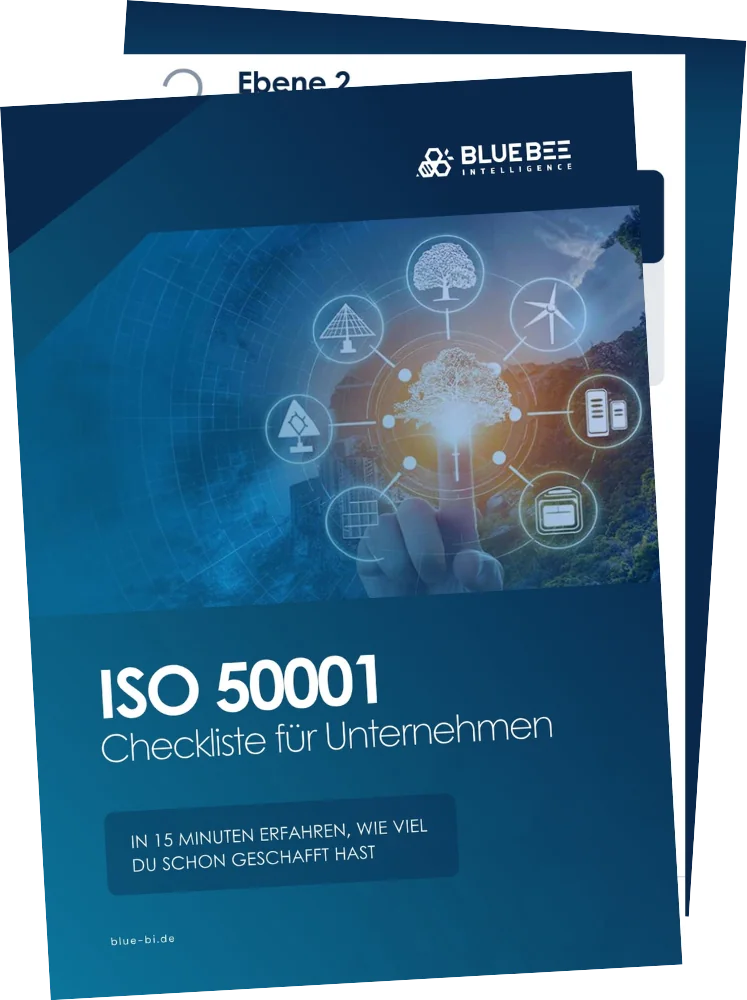
That’s exactly why we developed the ISO 50001 checklist. Not as a generic list of standards, but as an active working tool that immediately shows you where you stand.
Why Most ISO 50001 Checklists Don’t Work
There are hundreds of free ISO 50001 checklists available online. Most of them are simply a direct translation of the standard into a table: requirement, yes/no, comment. That’s not a practical tool—it’s just a blank form.
What these checklists are missing are three things:
- 1. Prioritization: Not all requirements are equally important. What constitutes a quick win — and what is a strategic project that takes months to complete?
- 2. Context: What does a requirement mean in practice? What will an auditor accept, and what will they not?
- 3. Action plan: What specific steps should I take if a requirement is not met?
Do you know which three points in your EnMS have the greatest impact on the audit results?

The 3-Level Model: The Structure Behind the Checklist
Our checklist follows the three-level model of ISO 50001 — the same logic that the auditor uses. Anyone who understands this model will immediately see why some companies pass audits with flying colors while others fail time and again on the same points.
Experience shows that almost everyone has Level 1 covered. Level 2 is incomplete for many. Level 3 — the documentation — is the most common cause of non-conformities. That is precisely why our checklist focuses on this area.
ISO 50001 requires documentation, but it doesn’t mean you have to drown in paperwork. Most Level 3 records can be automated through a smart BI system. If your measurement data and EnPIs land in the dashboard automatically, you’ve already got half the work done for your audit.
– Lucian Marginean, Senior ESG Consultant, Blue Bee IntelligenceExpert Scoring: Your Guide to Priorities
What sets our checklist apart from all others is our expert scoring system. Our team has evaluated every single requirement of the standard based on the effort it requires in practice. The result: three clear categories.
When preparing, start with all Score 1 items first. This creates quick wins and a clean foundational documentation. Then move on to the Score 3 topics – they take time, but they make the real difference.
– Christoph Töpfer, Managing Director, Blue Bee Intelligence
How to Use the Checklist Effectively
The checklist is intentionally designed so that you can work through it in four clear steps — without wasting any time:
When was the last time you took a systematic look at all three levels of your EnMS — not just to prepare for an audit, but just for the sake of it?
The biggest problem in audits is manual data entry errors in Excel. When the auditor sees that your data flows directly from the BI system, the issue of audit compliance is immediately resolved. No questioning, no recalculating — just clear, traceable numbers.
– Daniel Lutzenberger, ESG Consultant, Blue Bee IntelligenceWhat to do after downloading
The checklist is your starting point — not your end point. Here are the three steps that make all the difference after you download it:
- Step 1: Conduct the status check with your team — not on your own. The energy assessment and procedural guidelines are team tasks.
- Step 2: Derive a concrete action plan from the Score 3 points. Who does what by when? That’s the only thing that matters.
- Step 3: Determine whether BI-supported energy management makes sense for you. Automating Level 3 saves weeks — not hours — on your next audit.
✔ Expert scoring (1–3) for all requirements
✔ 3-level model (Manual – Procedures – Records)
✔ Full status overview in 20 minutes
➤ Download now

Would you like to know right after the status check where the greatest opportunities for your company lie? Schedule a free initial consultation with our ESG team today — we’ll review your situation together and show you how to transform your EnMS from a mandatory requirement into a genuine competitive advantage.


