





















Energy costs are rising, regulations are getting stricter, and investors are increasingly asking about your company’s carbon footprint. In this environment, one standard keeps coming up: ISO 50001. But what does it really entail?
Is ISO 50001 just another certificate that you have to renew every few years – or does it really offer a strategic advantage?
In this article, we’ll answer exactly that. You’ll learn what the standard entails, who it applies to, what it costs, and – more importantly – what concrete benefits it offers you. By the end, you’ll know whether ISO 50001 is a requirement or an opportunity for your business. Or both.
What is ISO 50001? The definition
ISO 50001 is the international standard for energy management systems (EnMS). It was developed by the International Organization for Standardization (ISO) and specifies how organizations can systematically monitor, analyze, control, and continuously improve their energy consumption.
The core principle is simple: If you don’t measure your energy consumption, you can’t control it. And if you don’t control it, you’re wasting money.
The standard follows the well-known PDCA cycle – Plan, Do, Check, Act – which is also familiar from other management standards such as ISO 9001 (quality) or ISO 14001 (environment). This makes it easy to integrate if you already operate other management systems.
What does the Standard cover? A brief Overview of the Key Chapters
ISO 50001 is divided into ten main chapters. Three of these form the core of the system – and it is precisely here that it is determined whether your energy management system truly works or exists only on paper.
- Chapter 6.3 – Energy Assessment: The Core. Here, you analyze which systems and processes consume the most electricity, heat, or compressed air. Without this foundation, everything else is just guesswork.
- Chapter 6.4 – Energy Baseline: You establish a reference value against which you can measure future consumption. It sounds simple, but it is the key to measurable progress.
- Chapter 6.5 – Energy Performance Indicators (EnPIs): Specific metrics such as kWh per production hour or heating energy per m². These figures make your progress visible – to management and to the auditor.
- Chapter 9.1 – Measurement, Analysis, Evaluation: Data must be collected and evaluated regularly. This is also the biggest weakness of many systems.
Are you sure your measurement data is currently organized in such a way that you could prepare it for an audit within hours – not weeks?

Who is ISO 50001 intended for?
There are two categories here that you should keep clearly separate:
1. Mandatory users
Since the Energy Efficiency Act (EnEfG) 2023 came into effect and the obligations under the EDL-G Directive took effect, certain companies are legally required to either implement an energy management system in accordance with ISO 50001 or conduct an energy audit in accordance with DIN EN 16247. This primarily affects non-SMEs with annual energy consumption exceeding certain thresholds. Those affected who fail to take action risk substantial fines.
2. Voluntary users – with strategic intent
SMEs and other companies can voluntarily implement ISO 50001. And this is often where the more compelling business case lies: The BAFA provides funding for exactly this – through non-repayable grants under the Federal Funding Program for Energy and Resource Efficiency (Module 3). Those who view certification as a strategic investment often recoup their costs faster than expected.
Do you know if your company is subject to the mandate – or if you can benefit from BAFA funding? If you’re not sure, read on.
How much does ISO 50001 certification cost?
This depends heavily on the size of the company and the maturity of the existing energy management system. As a rough guide:
- System implementation (in-house or with an external consultant): 5,000 to 30,000 euros
- Initial certification by an accredited body: 3,000 to 10,000 euros
- Annual surveillance audits: 1,500 to 5,000 euros
Sound like a lot? Then look at it from the other side.
The certification costs are not the issue for any of our clients. The problem is the internal preparation. Those who do not have their data under control pay with work time measured in weeks – not days. A smart BI system fundamentally changes this.
– Lucian Marginean, ESG Senior Consultant, Blue Bee Intelligence
What are the real benefits of ISO 50001? The honest answer
Short answer: More than most companies expect before implementation. Here are the three ways the standard pays off:
Level 1: Direct cost reduction
Companies that consistently implement ISO 50001 identify potential savings of 5 to 20 percent of their energy consumption on average. With annual energy costs of 500,000 euros, that amounts to up to 100,000 euros – per year.
Level 2: Subsidies and regulatory benefits
Certified organizations gain access to subsidies that would not be available without an EnMS. In addition, they benefit from tax advantages (peak load compensation) and a stronger negotiating position with energy suppliers.
Level 3: Strategic Competitive Advantages
By 2026, investors, banks, and major customers will be actively asking for an energy management system more and more often. Those who have one will open doors. Those who don’t will have to explain themselves.
If a potential major customer asked you tomorrow whether you have a certified EnMS – what would your answer be?
An excellent EnMS is not a paper tiger, but your most important tool for measurable cost reductions and strategic credit security. The companies that understand this early will be the benchmark in their industry in two years.
– Christoph Töpfer, Managing Director, Blue Bee IntelligenceThe 3 Biggest Misconceptions About ISO 50001
Misconception 1: “That’s only for large companies”
Wrong. ISO 50001 is scalable and is successfully implemented by companies with as few as 20 employees. The requirements grow in line with the complexity of the organization.
Misconception 2: “We’ll have to redocument everything”
Not necessarily. Many companies already have processes and data that just need to be organized. With a solid energy data management system, this can often be done faster than expected.
Misconception 3: “This is a one-time project”
ISO 50001 isn’t a project – it’s a continuous improvement process. But that’s exactly what makes it so valuable: you’re building a system that delivers results year after year.

Your next step: Where do you stand today?
Now that you know what ISO 50001 is and what it offers, a specific question arises: Where does your company stand right now? Which requirements of the standard do you already meet – and where are the biggest gaps?
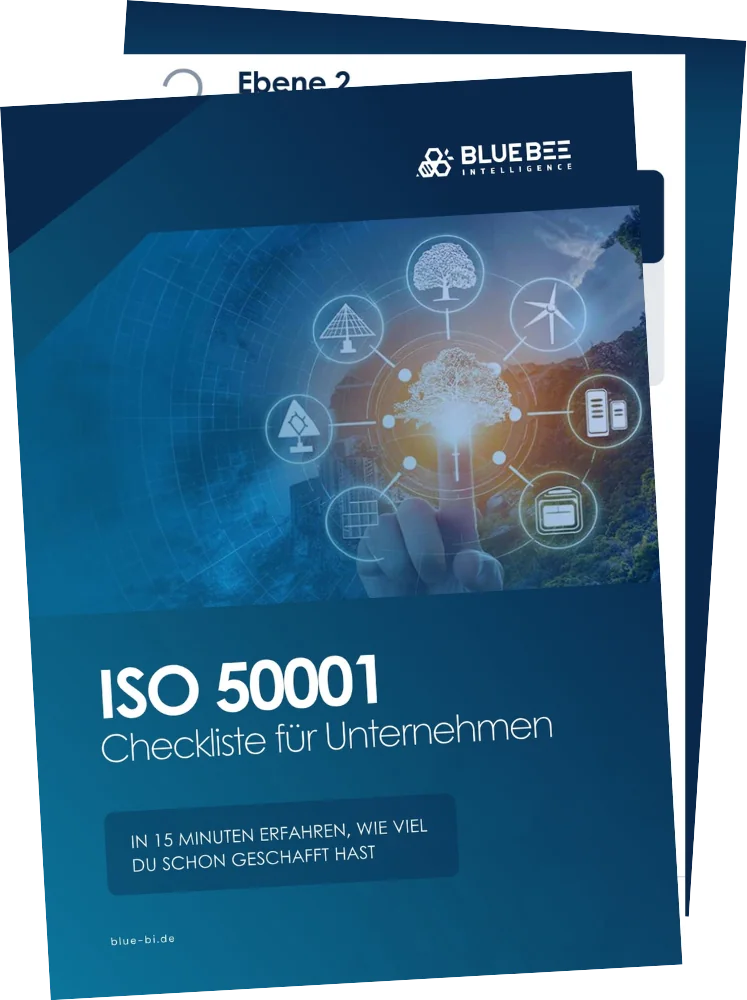
That’s exactly why we developed the ISO 50001 checklist from Blue Bee Intelligence. In just 20 minutes, you can assess your status across all three levels – using our expert scoring system, which immediately shows you where you can achieve quick wins and where your strategic focus should lie.
Or would you like to speak directly with one of our experts? Then schedule a free initial consultation now – together, we’ll identify where you can make the biggest impact.


